Grateful for a little push
How my son's playground scuffles relate to artificial intelligence


On Friday mornings, I meet up with two friends and their young children around the same age as my son. It's a great time to connect with other adults and also to see how my son interacts with his peers. Sometimes, one of the children will push him. I try not to intervene until a certain point, especially since very often he has actually instigated it. He’s still developing social skills, and does what he can to push her buttons.
He wants to see what her reaction will be, and who am I to stop him from learning?
Hopefully, one day he will understand cause and effect– that the more that you push somebody's buttons, the more likely they are to not want to play with you.
While his small childhood scuffles might seem totally unrelated to artificial intelligence, I’ve often considered their connections.
As a mother, I don’t like to see my child get hurt. It doesn’t feel good when he cries.. But I also recognize that it's important for him to learn the lesson that if he does X, Y will happen. Because of that, I’m greatly appreciative of the little girl and her very often quite reasonable responses to his actions.
How does this relate to our age of machines?
Artificial intimacy. It’s a phenomenon in which an individual will form social connections, emotional bonds, or intimate relationships with various forms of artificial intelligence, including chatbots, virtual assistants, and other artificial entities—due to a relationship that is perceived to be reciprocal.
I read a few weeks ago that tech companies were planning on creating AI companions not just for adults who are already quite susceptible to artificial intimacy, but also for children.
This is not some life-size toy like the slightly creepy giant Barbie my grandparents got for me as a child. Nor is it like the Furbie that kept me up at night with its sounds until I stuffed it into a closet in the basement, relegated to annoying no one until its batteries died. These AI companions would be “friends” that understood everything about the person they were matched with, that knew what to say to make that person happy and feel good about themselves, that avoided any sort of friction because at the end of the day, they would be a product and it would be a business.
Ignoring my own misgivings and biases against machine relationships in general, there’s a bigger issue at play here–one that relates to the girl pushing my son on the playground.
Human relationships are not all “yes” moments. AI chatbots are notoriously sycophantic–and can skew how people look at other humans, who are naturally not so. Friends and family push us, they challenge us, and they have opposing goals in life that we sometimes need to compromise for. But those things aren’t bad–they help us grow, they challenge our self-centered mentalities, and they make us better people.
And when we are children, we are learning to be better people. When I was working in schools, I saw firsthand how important early childhood is. We learn to share, to empathize with others, to make friends.
We learn to be better human beings.
And for that to happen, a child needs other children that will push back. At such a crucial phase of personality development, it seems dangerous to provide a child with a friend that will not respond with anger when the child pushes their buttons, and that will not teach them that sometimes their actions hurt others, that sometimes their feelings may rub up against other feelings, and that sometimes they are simply wrong.
What are your thoughts on artificial intimacy?
Riv
Don't be shy. Send me your answers to rivka.begun@gmail.com. I'd love to feature your story in next month's newsletter.
P.S I'm always looking to improve! I'd love to hear your thoughts (or a quick hello) in my Feedback Form
What to read this month

This book was thought-provoking, funny, and engaging. I couldn’t put it down.
From Goodreads:
A dark comedy about second acts, creative appropriation, and the racial identity–industrial complex
Jane has high hopes her life is about to turn around. After years of living precariously, she; her painter husband, Lenny; and their two kids have landed a stint as house sitters in a friend’s luxurious home in the hills above Los Angeles, a gig that coincides magically with Jane’s sabbatical. If she can just finish her latest novel, Nusu Nusu, the centuries-spanning epic Lenny refers to as her “mulatto War and Peace,” she’ll have tenure and some semblance of stability and success within her grasp.
But things don’t work out quite as hoped. In search of a plan B, like countless writers before her, Jane turns her desperate gaze to Hollywood. After she meets with a hot young producer to create “diverse content” for a streaming network, he seems excited to work with a “real writer.” She can create what he envisions as the greatest biracial comedy to ever hit the small screen. Things finally seem to be going right for Jane—until they go terribly wrong.
Buy it on Bookshop here
Book news
I’m out on submission with a book close to my heart inspired by my great-grandmother.
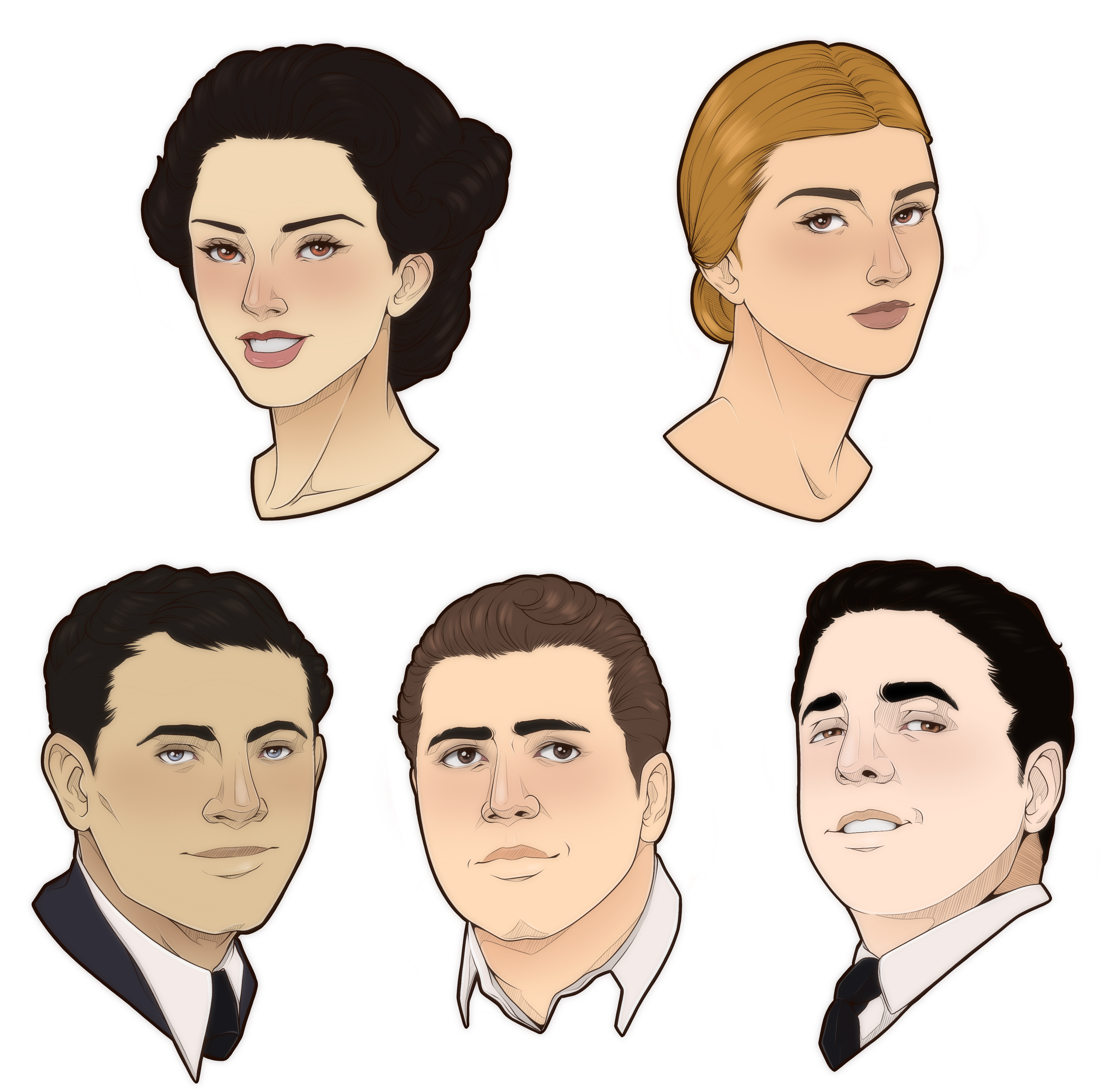
Last year I had an artist draw some of the characters from the book that I’d love to show here!
I love this story and these characters, the real versions and the inspiring people they’re based on.